Holy Week and Easter weekend with St Teresa's choir has been hectic, amazing, challenging and inspiring. Wednesday's rehearsal included covering everything for the upcoming services and went on past 10 pm. The conductors were in that mood common to all choral directors before a big performance. Perhaps the funniest moment was my section being told off for mispronouncing "flowing". The whole choir laughed, as even though I was right, the section stands as one so it's still pretty funny.
All week I have felt a cold coming on and on Wednesday it finally emerged. Obviously I'm still at that stage where I think all illnesses could be malaria despite diligently taking anti-malarials, tucking in my net and wearing repellents, and utterly regardless of different symptoms. It was late and there was a definite chill in the air. Margaret, a primary school teacher and alto who lives in my direction, took me under her wing and we jumped in a 77 (a taxi which works a bit like a London bus and where a single costs 7 Delasi (14p)). The taxi driver drove me right home, which isn't on route and should've cost more but such is the nature of kindness often found here.
What followed was the worst night's sleep I've had in a long time. My mattress has a body shaped dent in the centre despite turning, my cold was streaming and at about 3am the slats fell out from under my bed. At 5am ish the call to prayer started so at least I knew what time it was. Also one of the singers (apologies for not knowing the correct term) has a very melodious voice and he was singing this morning. I shoved a pillow into the dent, curled up and dreamt a mixed day/sleep dream about something horrific (removing tumbu (sp?) fly maggots from my arms) and saving up to buy a sprung mattress. I practiced saying mangee feebar (I have sickness), treated myself to a warm wash from a bucket and headed to work where friendship and adventure awaited.
(n.b. when you read this remember this was some time ago. At the time of publication I'm fine, listening to some drumming, and have reconstructed my bed!)
Friday, 29 March 2013

So, let's get started...
Our in country training programme (ICT) is now finished. It concluded with a language test. 99% for me, but the nicest element was finding a text from Katy the soprano in choir wishing me luck. I took her a photo of my own Katharine the soprano to show her as a gesture of thanks. It's really great to know that I am making friends ndanke (slowly, and my friend is "suma xarit", pronounced harit and presumably from the root "caritas")).
With the end of ICT, gone are the days of long walks to the VSO office in the morning sun, lunch ordered in and cool drinks stored in the fridge for us to help ourselves. I had become rather used to the luxury of this system; killing a couple of cockroaches before work still seems to deserve a treat for me, it's not yet become purely just a slightly gruesome addition to the morning routine.
And so it's the first day at the National Youth Service Scheme (NYSS). The scheme is a satellite of the Ministry of Youth and Sports and was created to combat youth poverty through providing supported access to valuable training. It's usually a two year programme for about 200 young people.
What follows in this blog is the impressions of someone on her first day. Any mistakes I've made are my personal misunderstanding, to be corrected as I learn. Day one involved being dropped at the office by VSO for a brief tour with the Deputy Executive Director, Mr Ebou Sow, who was very pleased to learn that my Gambian name as presented by my teacher is Haddy Ceesay, also his mother's name.
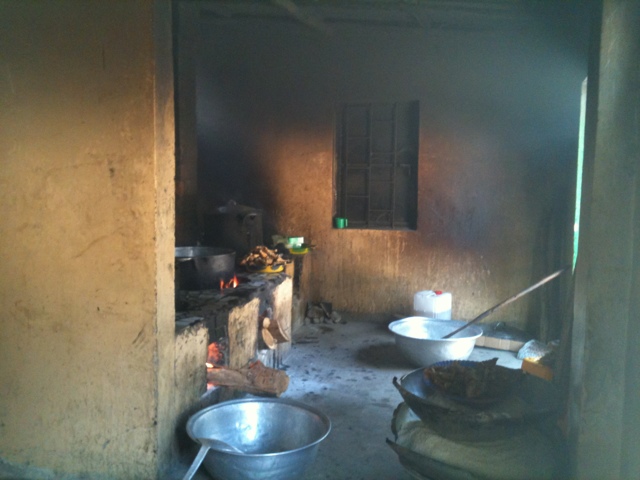
We then headed up to the NYSS orientation camp where they, with National Enterprise Development Initiative (NEDI), are accommodating and hosting training on business enterprise skills. The training itself is at the President's International Award (PIA) centre next door. The NYSS camp has been recently refurbished and has the atmosphere of a youth hostel. I joined then in time for a lunch of white Benacin which I attempted to eat with my hand, al Africano. [see photos, the kitchen and courtyard] As I dusted oily rice off my skirt I was once again struck that I must look like a child when I eat. Still, practice makes perfect and I was predictably invited to join a few bowls as the newcomer. Needless to say there was no need for an evening meal so I'm not sure how I managed to eat fried chicken only two hours later.
As any new employee I was pretty useless for the first day but managed to battle with technology and electricity cuts to transfer a presentation from word to simple PowerPoint. Some of the trainees aren't literate so I will have to think more carefully about how to make presentations more accessible in future. As it happened the power failed before the presentation so I sat and listened to the content as the temperature rose, trying not to become too drowsy. Having to introduce myself in Wolof helped with that, as did the fact that the content was good; relevant, well pitched and well delivered. The young people were totally engaged though, taking the advice seriously as they plan their futures. [see photo]
The day ended in that relaxed way of youth work where workers join young people in their spaces to be available to solve issues and interact. I sat while a very driven young entrepreneur brewed a strong attaya, it was like espresso, and another colleague offered me a share in his fried chicken. With choir practice moved for a funeral I was free to spend as long at work as seemed needed.
I walked back to the compound at around 7; it's only 10 minutes away across the highway and down a sandy track. As I went I passed the PIA sign and thought my old friends would be pleased to see that the brand we worked on has got this far. [see photo] As I start on work here my fervent hope is that by the end I can look back on VSO in the same way that I look back on that great DofE team, with both fondness and pride in our achievements.


With the end of ICT, gone are the days of long walks to the VSO office in the morning sun, lunch ordered in and cool drinks stored in the fridge for us to help ourselves. I had become rather used to the luxury of this system; killing a couple of cockroaches before work still seems to deserve a treat for me, it's not yet become purely just a slightly gruesome addition to the morning routine.
And so it's the first day at the National Youth Service Scheme (NYSS). The scheme is a satellite of the Ministry of Youth and Sports and was created to combat youth poverty through providing supported access to valuable training. It's usually a two year programme for about 200 young people.
What follows in this blog is the impressions of someone on her first day. Any mistakes I've made are my personal misunderstanding, to be corrected as I learn. Day one involved being dropped at the office by VSO for a brief tour with the Deputy Executive Director, Mr Ebou Sow, who was very pleased to learn that my Gambian name as presented by my teacher is Haddy Ceesay, also his mother's name.
We then headed up to the NYSS orientation camp where they, with National Enterprise Development Initiative (NEDI), are accommodating and hosting training on business enterprise skills. The training itself is at the President's International Award (PIA) centre next door. The NYSS camp has been recently refurbished and has the atmosphere of a youth hostel. I joined then in time for a lunch of white Benacin which I attempted to eat with my hand, al Africano. [see photos, the kitchen and courtyard] As I dusted oily rice off my skirt I was once again struck that I must look like a child when I eat. Still, practice makes perfect and I was predictably invited to join a few bowls as the newcomer. Needless to say there was no need for an evening meal so I'm not sure how I managed to eat fried chicken only two hours later.
As any new employee I was pretty useless for the first day but managed to battle with technology and electricity cuts to transfer a presentation from word to simple PowerPoint. Some of the trainees aren't literate so I will have to think more carefully about how to make presentations more accessible in future. As it happened the power failed before the presentation so I sat and listened to the content as the temperature rose, trying not to become too drowsy. Having to introduce myself in Wolof helped with that, as did the fact that the content was good; relevant, well pitched and well delivered. The young people were totally engaged though, taking the advice seriously as they plan their futures. [see photo]
The day ended in that relaxed way of youth work where workers join young people in their spaces to be available to solve issues and interact. I sat while a very driven young entrepreneur brewed a strong attaya, it was like espresso, and another colleague offered me a share in his fried chicken. With choir practice moved for a funeral I was free to spend as long at work as seemed needed.
I walked back to the compound at around 7; it's only 10 minutes away across the highway and down a sandy track. As I went I passed the PIA sign and thought my old friends would be pleased to see that the brand we worked on has got this far. [see photo] As I start on work here my fervent hope is that by the end I can look back on VSO in the same way that I look back on that great DofE team, with both fondness and pride in our achievements.
Palms, procession and the perfect passer-by
Palm Sunday came along in its usual way, though i thought I'd feel less new by Easter. Warned three times at choir rehearsal to be on time, quarter to 9 for a 9 am procession up the highway to 10am mass, I rushed to get up and out. However, unhelpfully, it was one of the worst mornings for anti-malarial nausea meaning everything took twice as long as it should, i was running late and I felt pretty grim. Therefore I treated myself to a taxi, and didn't even haggle the D50 (c.£1) fare down further. I felt a bit grand pulling up in it though.
Children offered to sell me palm branches, whole ones, not the wispy leaves we get in the UK. Everyone laughed at that but obviously someone here had literally just climbed up and pulled them down from local trees rather than having to import them. My conductor Sangay bought a branch for me and, being the only choristers around, we sat under the shade of trees and learnt more about each other. His mother and wife sing in the choir too and we talked about our shared passion for singing.
People started to assemble and at about 9.30 a huge pick up truck with drum kit, singers and pretty enormous PA system drove in. The cross went first, then the van, the children, choir and everyone. As I joined in the music we shook our palms, filled the street and danced up the road. It was brilliant, and felt biblical (technological advances excepted). The soprano section were pretty impressed with my dancing skills. It was also quite nice to be making the taxis go round us, the drivers here will usually expect pedestrians to move for them, even when lurching off road, so it felt like payback.
We entered the church, sang our music and the mass was as normal. However the Passion reading was in Wolof so that was an exercise in trying to pick the words I know versus the story I know. The sermon was on examples of poor attitudes in the reading. I like the priest; he gives his sermons in both English and Wolof and seems to be keen on making them theologically accurate and practically relevant.
Walking home was hard. It was now past midday. The sun was hot and it seemed like I could feel every item of clothing and each thread was irritating and chaffing. Many cars beep as they pass, as a warning to you or others, as notice that there's space in a taxi, for some other reasons I'm still working out. Therefore I'm used to ignoring beeps and mainly tutting when cars lurch off the Tarmac in front of where I'm walking. On Palm Sunday a car did just that. As I stepped away seeking a patch of firmer ground I became aware the driver was offering me a lift. She was driving from church and had seen me in the choir. What a legend! Lovely Gracie dropped me home. I twisted a bit of palm into a cross to say thanks. Now the rest of the Sunday was free for chatting, eating and a trip to find a pool and Internet.
Children offered to sell me palm branches, whole ones, not the wispy leaves we get in the UK. Everyone laughed at that but obviously someone here had literally just climbed up and pulled them down from local trees rather than having to import them. My conductor Sangay bought a branch for me and, being the only choristers around, we sat under the shade of trees and learnt more about each other. His mother and wife sing in the choir too and we talked about our shared passion for singing.
People started to assemble and at about 9.30 a huge pick up truck with drum kit, singers and pretty enormous PA system drove in. The cross went first, then the van, the children, choir and everyone. As I joined in the music we shook our palms, filled the street and danced up the road. It was brilliant, and felt biblical (technological advances excepted). The soprano section were pretty impressed with my dancing skills. It was also quite nice to be making the taxis go round us, the drivers here will usually expect pedestrians to move for them, even when lurching off road, so it felt like payback.
We entered the church, sang our music and the mass was as normal. However the Passion reading was in Wolof so that was an exercise in trying to pick the words I know versus the story I know. The sermon was on examples of poor attitudes in the reading. I like the priest; he gives his sermons in both English and Wolof and seems to be keen on making them theologically accurate and practically relevant.
Walking home was hard. It was now past midday. The sun was hot and it seemed like I could feel every item of clothing and each thread was irritating and chaffing. Many cars beep as they pass, as a warning to you or others, as notice that there's space in a taxi, for some other reasons I'm still working out. Therefore I'm used to ignoring beeps and mainly tutting when cars lurch off the Tarmac in front of where I'm walking. On Palm Sunday a car did just that. As I stepped away seeking a patch of firmer ground I became aware the driver was offering me a lift. She was driving from church and had seen me in the choir. What a legend! Lovely Gracie dropped me home. I twisted a bit of palm into a cross to say thanks. Now the rest of the Sunday was free for chatting, eating and a trip to find a pool and Internet.
Becoming a honorary citizen of Ndemba village
On our VSO induction timetable today was scheduled as the "community experience". This meant a trip south for about 1 3/4 hours to a village called Ndemba. I was at the corner of the street by the early-for-a-Saturday time of 8 am, whistling an appropriate George Formby song and reassuring passing taxi drivers that I didn't need their assistance today. After a brief chat with passing Janneke, on her way to another village for work, I jumped into a smart looking van at 8.25, greeting the waiting VSO staff and fellow volunteers. We continued the pick ups and, when we were all present and correct, the VSO staff handed round breakfast of sandwiches and water. The breakfast sandwiches of the Kombos are a thing to see; there are stalls around the area with a seller, usually a woman, a pile of crusty French style bread (Tapalapa) and various fillings. They're much more like a British lunch than breakfast, and are enormous, half is more than enough. The fillings could be steak, bean, liver, shrimp, chicken or a kind of fried beanballs, often with salad, mayonnaise and ketchup. This morning my steak tapalapa did a great job of easing the post anti-malarial nausea.
The journey itself was interesting, driving south past sights including the airport (last seen at 5am), Brikama, where Jonson and Yaap will work, and the entrance to on of the NYSS training centres which is a farm. We also saw empty rice paddies which will be cultivated when the rain comes, cashew plantations (a major cash crop), and palm trees. This country certainly manages to be very beautiful. However, having been nominated to give a vote of thanks I missed some sights in a bid to rehearse my now quadrilingual speech.
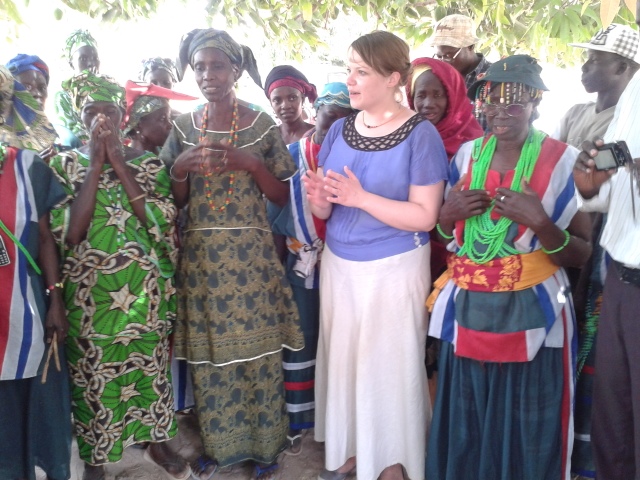
Arriving in Ndemba as strangers our first task, as it would be in any village, is to greet the Alkalo, the village head. The Elders came to greet us too, alongside members of the Village Development Committee. As we sat under an enormous mango tree a group of women carrying a Cora, singing and clapping danced their way towards us. We were treated to a welcome song and the Gambian national anthem. It was fairly breathtaking and the women's lack of any inhibition countered our own slight culture shock.
The Alkalis (there're two in Ndemba), elders, VDC and community then hosted a Q&A session for us. After feeling very proud for introducing myself without the beed for a translator, I asked a question about how the women's structures are organised which caused a bit of commotion to work out which woman would speak, as many were keen to explain. It was soon sorted and we heard about the community garden which we later visited. My second question on saving up for the irrigation system the women said would help them revealed that there's a kind of community saving scheme to pay for some development, as well as a structure like a credit union and development grants from the local council.
There are a few income sources for the village and its inhabitants. We walked to the river via a cassava farm and an Eco-tourism lodge, and back via a freshwater spring, bee hive and the garden. There's also a bus run by the VDC for the local area. At the river a few of the children jumped in. "Come swimming" one shouted at me and I was very tempted given the soaring temperature. The river is saltwater too so the risk of parasites is lower, though apparently they do get crocodiles. I regretfully decided to stay professional and learn about the boat that can take produce and people from here to the capital instead.
Returning to the welcome shade of the mango tree we sat to wait for lunch and prayers. Aisah went to speak to the dancing women and, unable to resist, I went to join them. We were soon singing and clapping along to the Cora, which rapidly became about half an hour of dancing, stamping in a circle and improvising various harmonies and words via my trusty "read lips and smile". I even tried to teach some of the women a version of Syahamba and we laughed with each other until food arrived.
Our dancing friends invited us to eat with them, a central point of Gambian table manners. Using our right hands we took small amounts of rice and fish sauce. It didn't take long for someone to wordlessly pass me a cloth to use essentially as a bib/apron as my inexpert technique was frankly terrible. I must have looked like a small child learning to eat! We asked them to join us at our bowls of Benacin and Domida with cous (like sourgum) and were soon "bon poyin", spelling uncertain but Jola for full. I told them my sister Katharine would appreciate that one, given "embonpoint" is a favourite term of hers.
Finally, we had a chance to pray with and talk to the village development committee after which we were told to consider ourselves as honorary citizens and to always know that wherever we are we have another village waiting for us there. All that was left was then to dance the day away and get a few more corrections to my very limited Jola vocabulary. Jumping back in the van the heat and sun was weighing heavily on us all but with an elation of a day spent in wonderful, interesting and joyful company.
[photos: Kadambari, Longworth, Watts]


The journey itself was interesting, driving south past sights including the airport (last seen at 5am), Brikama, where Jonson and Yaap will work, and the entrance to on of the NYSS training centres which is a farm. We also saw empty rice paddies which will be cultivated when the rain comes, cashew plantations (a major cash crop), and palm trees. This country certainly manages to be very beautiful. However, having been nominated to give a vote of thanks I missed some sights in a bid to rehearse my now quadrilingual speech.
Arriving in Ndemba as strangers our first task, as it would be in any village, is to greet the Alkalo, the village head. The Elders came to greet us too, alongside members of the Village Development Committee. As we sat under an enormous mango tree a group of women carrying a Cora, singing and clapping danced their way towards us. We were treated to a welcome song and the Gambian national anthem. It was fairly breathtaking and the women's lack of any inhibition countered our own slight culture shock.
The Alkalis (there're two in Ndemba), elders, VDC and community then hosted a Q&A session for us. After feeling very proud for introducing myself without the beed for a translator, I asked a question about how the women's structures are organised which caused a bit of commotion to work out which woman would speak, as many were keen to explain. It was soon sorted and we heard about the community garden which we later visited. My second question on saving up for the irrigation system the women said would help them revealed that there's a kind of community saving scheme to pay for some development, as well as a structure like a credit union and development grants from the local council.
There are a few income sources for the village and its inhabitants. We walked to the river via a cassava farm and an Eco-tourism lodge, and back via a freshwater spring, bee hive and the garden. There's also a bus run by the VDC for the local area. At the river a few of the children jumped in. "Come swimming" one shouted at me and I was very tempted given the soaring temperature. The river is saltwater too so the risk of parasites is lower, though apparently they do get crocodiles. I regretfully decided to stay professional and learn about the boat that can take produce and people from here to the capital instead.
Returning to the welcome shade of the mango tree we sat to wait for lunch and prayers. Aisah went to speak to the dancing women and, unable to resist, I went to join them. We were soon singing and clapping along to the Cora, which rapidly became about half an hour of dancing, stamping in a circle and improvising various harmonies and words via my trusty "read lips and smile". I even tried to teach some of the women a version of Syahamba and we laughed with each other until food arrived.
Our dancing friends invited us to eat with them, a central point of Gambian table manners. Using our right hands we took small amounts of rice and fish sauce. It didn't take long for someone to wordlessly pass me a cloth to use essentially as a bib/apron as my inexpert technique was frankly terrible. I must have looked like a small child learning to eat! We asked them to join us at our bowls of Benacin and Domida with cous (like sourgum) and were soon "bon poyin", spelling uncertain but Jola for full. I told them my sister Katharine would appreciate that one, given "embonpoint" is a favourite term of hers.
Finally, we had a chance to pray with and talk to the village development committee after which we were told to consider ourselves as honorary citizens and to always know that wherever we are we have another village waiting for us there. All that was left was then to dance the day away and get a few more corrections to my very limited Jola vocabulary. Jumping back in the van the heat and sun was weighing heavily on us all but with an elation of a day spent in wonderful, interesting and joyful company.
[photos: Kadambari, Longworth, Watts]
The week of 8 languages
Language lessons have continued. There are 4 of us in my class, another class also learning Wollof and another learning Mandinka, which I'm also learning at home, partly from Idrisa who only speaks Mandinka and French. Trying to get two languages to stick in my head is tricky but it becomes an impossible dream when I have to pick the right one to address someone in, or listen properly, and pick from two languages to ask for clarification in too. It'll come in time; hopefully by Monday's test.
The lessons aim to cover the very basics of language but also touch on culture. That's how Wednesday's trip to practice our buying things vocabulary at Serrekunda Market very quickly became "let's get stuff for Benacin (meaning one pot - rice with vegetables/meat/fish) and go to Awr's compound for a taste of Gambian family life". It was quite a feast and the extended family in the compound were happy to show us how to cook, how to light a fire, how to mix wonjo (I think its hibiscus flowers) and baobab juices and generally host us wonderfully and with good humour at our many faux pas.
The compound is a village type set up, with a courtyard in the centre and single storey rooms and houses round the edges. There are goats and chickens in the courtyard, as well as spaces for cooking, washing, parking the car and, perhaps most importantly, sitting drinking tea under the mango tree. The people in the compound include Awr's family, her brother in law's family and a number of other children who are in town for school as their families live in villages. One girl is the first ever in her family to go to secondary school. There are also, as in any household with teenagers, various friends popping in. In the Gambia, a bit like at my Gran's house, when food is ready everyone is invited to eat. It is usually served in huge shared bowls which you pick bits from with your hand.
However, the deep end of learning languages is my new choir. As decisions go joining the church choir wasn't the most difficult. The process was something like: do I go to church? Yes. Do I need to be in a choir? Yes. Do I enjoy African music? Yes. Do I like having a link to the community beyond work? Yes. So here's an African church choir in your local community for you. Seems to tick all the boxes. So the decision is fine. Strategically perhaps joining a church choir in which most directions are given in a language you can only say hello in, and joining at Easter, one of the busiest musical times, was to pick a hefty challenge. Nightly rehearsals meant that Seikou from my compound said he thought I'd decided to go back to the UK!
Through listening, reading the context and saying "ndanke" (slowly) a lot I can at least begin to talk to and understand who is in the choir. Having met at least 200 people this week I've managed to offend most fellow choristers by forgetting their names within seconds. At least the music is familiar, or so I hoped. We started with Latin, so far so good. Then English, a hymn I didn't know but not difficult to read. However, there my luck ran out and we ran through hymns from across west Africa, with Jola, Fula (other tribes in the region), a bit more French and Creole making an appearance. At the end of the first rehearsal they asked me to introduce myself. I got as far as I could in Wolof which was pretty far (name, homeland, current home) for someone who was still excited because I managed to buy an orange without using English or pointing alone two hours earlier.
By the end of the week I'm much better at lip reading when singing so I can get somewhere near the sound and there's a lot of effort at choir to make sure I have a copy of notated music when there is one. Plus conductor rants seem to be pretty obvious whatever the language. "altos, where was that entry?" or "tenors, are you taking this seriously?" does cross the linguistic barrier pretty easily.
This Saturday sees a trip to Ndembe village. I have been nominated to give a vote of thanks. The village is Mandinka and Jola so we've worked out a speech in four languages; Wollof, Mandinka, Jola and Fula. If I could add English, French and Creole in it'd really round off the week of eight languages well. I just hope I don't mispronounce something to a horrific extent!
[photo by Rao]

The lessons aim to cover the very basics of language but also touch on culture. That's how Wednesday's trip to practice our buying things vocabulary at Serrekunda Market very quickly became "let's get stuff for Benacin (meaning one pot - rice with vegetables/meat/fish) and go to Awr's compound for a taste of Gambian family life". It was quite a feast and the extended family in the compound were happy to show us how to cook, how to light a fire, how to mix wonjo (I think its hibiscus flowers) and baobab juices and generally host us wonderfully and with good humour at our many faux pas.
The compound is a village type set up, with a courtyard in the centre and single storey rooms and houses round the edges. There are goats and chickens in the courtyard, as well as spaces for cooking, washing, parking the car and, perhaps most importantly, sitting drinking tea under the mango tree. The people in the compound include Awr's family, her brother in law's family and a number of other children who are in town for school as their families live in villages. One girl is the first ever in her family to go to secondary school. There are also, as in any household with teenagers, various friends popping in. In the Gambia, a bit like at my Gran's house, when food is ready everyone is invited to eat. It is usually served in huge shared bowls which you pick bits from with your hand.
However, the deep end of learning languages is my new choir. As decisions go joining the church choir wasn't the most difficult. The process was something like: do I go to church? Yes. Do I need to be in a choir? Yes. Do I enjoy African music? Yes. Do I like having a link to the community beyond work? Yes. So here's an African church choir in your local community for you. Seems to tick all the boxes. So the decision is fine. Strategically perhaps joining a church choir in which most directions are given in a language you can only say hello in, and joining at Easter, one of the busiest musical times, was to pick a hefty challenge. Nightly rehearsals meant that Seikou from my compound said he thought I'd decided to go back to the UK!
Through listening, reading the context and saying "ndanke" (slowly) a lot I can at least begin to talk to and understand who is in the choir. Having met at least 200 people this week I've managed to offend most fellow choristers by forgetting their names within seconds. At least the music is familiar, or so I hoped. We started with Latin, so far so good. Then English, a hymn I didn't know but not difficult to read. However, there my luck ran out and we ran through hymns from across west Africa, with Jola, Fula (other tribes in the region), a bit more French and Creole making an appearance. At the end of the first rehearsal they asked me to introduce myself. I got as far as I could in Wolof which was pretty far (name, homeland, current home) for someone who was still excited because I managed to buy an orange without using English or pointing alone two hours earlier.
By the end of the week I'm much better at lip reading when singing so I can get somewhere near the sound and there's a lot of effort at choir to make sure I have a copy of notated music when there is one. Plus conductor rants seem to be pretty obvious whatever the language. "altos, where was that entry?" or "tenors, are you taking this seriously?" does cross the linguistic barrier pretty easily.
This Saturday sees a trip to Ndembe village. I have been nominated to give a vote of thanks. The village is Mandinka and Jola so we've worked out a speech in four languages; Wollof, Mandinka, Jola and Fula. If I could add English, French and Creole in it'd really round off the week of eight languages well. I just hope I don't mispronounce something to a horrific extent!
[photo by Rao]
Friday, 22 March 2013
Introducing my fellow volunteers
Given that I will undoubtedly refer to them over the coming years I thought I should add a brief summary of my fellow volunteers. That and I have been asked to by a regular reader.
When we arrived there were already volunteers in post from previous cohorts. This includes Nicola who provided my tour of Kanifing on my first night at home, Natalie who is currently working on evaluation across VSO programmes and so has been key to both our induction programme and made sure my cohort and I get regular invitations to social events (which is NOT always going to the beach), and Helen (yes, there's a troy of Helens here as everywhere) who has provided tireless support in terms of organising tours and presentations on her experiences of Gambian culture. They, and others in their group and network have made integrating into Gambian life pretty smooth. Nicola's boyfriend has even declared that I am like his sister and so is now known as "suma mag", meaning my older sibling. I haven't yet met my housemate Agnes as she's been away.
In my cohort we have a fantastic mix of skills, interests, cultures and personalities. There is (see photo, from left to right) Rao, Aisah, Munya, Julie, Martin, Joe, Jonson and me, as well as Yaap and Janneke who are not pictured.
The fabulous Dr Rao (UK) is a psychiatrist and is already investigating the mental health provision here. Investigation is a real Rao trait and I have found out a lot about everyone's work through listening while he asks questions. Dr Joe (UK), who'll be in A&E, however seems to get a lot of questions asked of him about all sorts of medical matters. He's good at answering them and currently he's investigating keeping chickens.
Aisah (Phillipines) is a rural development adviser. She'll be working up country and will be a friendly face to share attaya (local green tea) with when I'm visiting our project nearby.
Munya (Zimbabwe), Martin (UK, specifically Yorkshire), and Jonson are the agricultural team. Jonson will be out in Brikama and Munya and Martin here in the Kombos. They are all very jovial and like cracking jokes, but workwise Martin and Munya have pretty serious knowledge of agriculture, and Jonson is statistical whizz.
Yaap and Janneke (Netherlands) arrived before us and so are already working. Seeing them at work and with their employers as we did on Monday is really helpful as it gives a reasonable impression of how those of us doing similar work, as I am, can expect to progress. They have also volunteered before so have lots of helpful tips.
And of course finally I'm working on youth policy with the National Youth Service Scheme (NYSS). Having met with the Executive Director on Monday I'm keen to get started and to learn more about how the programme works as well as what I can contribute. No doubt my fellow volunteers will feature regularly, but if you want another perspective I'd recommend reading Martin Watts' blog on Wordpress or Raokadambari.wordpress.com.

When we arrived there were already volunteers in post from previous cohorts. This includes Nicola who provided my tour of Kanifing on my first night at home, Natalie who is currently working on evaluation across VSO programmes and so has been key to both our induction programme and made sure my cohort and I get regular invitations to social events (which is NOT always going to the beach), and Helen (yes, there's a troy of Helens here as everywhere) who has provided tireless support in terms of organising tours and presentations on her experiences of Gambian culture. They, and others in their group and network have made integrating into Gambian life pretty smooth. Nicola's boyfriend has even declared that I am like his sister and so is now known as "suma mag", meaning my older sibling. I haven't yet met my housemate Agnes as she's been away.
In my cohort we have a fantastic mix of skills, interests, cultures and personalities. There is (see photo, from left to right) Rao, Aisah, Munya, Julie, Martin, Joe, Jonson and me, as well as Yaap and Janneke who are not pictured.
The fabulous Dr Rao (UK) is a psychiatrist and is already investigating the mental health provision here. Investigation is a real Rao trait and I have found out a lot about everyone's work through listening while he asks questions. Dr Joe (UK), who'll be in A&E, however seems to get a lot of questions asked of him about all sorts of medical matters. He's good at answering them and currently he's investigating keeping chickens.
Aisah (Phillipines) is a rural development adviser. She'll be working up country and will be a friendly face to share attaya (local green tea) with when I'm visiting our project nearby.
Munya (Zimbabwe), Martin (UK, specifically Yorkshire), and Jonson are the agricultural team. Jonson will be out in Brikama and Munya and Martin here in the Kombos. They are all very jovial and like cracking jokes, but workwise Martin and Munya have pretty serious knowledge of agriculture, and Jonson is statistical whizz.
Yaap and Janneke (Netherlands) arrived before us and so are already working. Seeing them at work and with their employers as we did on Monday is really helpful as it gives a reasonable impression of how those of us doing similar work, as I am, can expect to progress. They have also volunteered before so have lots of helpful tips.
And of course finally I'm working on youth policy with the National Youth Service Scheme (NYSS). Having met with the Executive Director on Monday I'm keen to get started and to learn more about how the programme works as well as what I can contribute. No doubt my fellow volunteers will feature regularly, but if you want another perspective I'd recommend reading Martin Watts' blog on Wordpress or Raokadambari.wordpress.com.
Sunday, 17 March 2013
Helen la tuda (my name is Helen)
Salaam alecum. Nanga def? Mangi fi rek. Thanks to a few tips from another VSO on training, questioning of locals and my pacing practice I had a vague idea of some rudiments of Wolof. And of course I habitually try to be at the front of the class, rehearsing and doing home work (OK, chatting to my compound family), trying to get the best pronunciation. It's not purely the latent swot; people here love to chat to new faces and being able to reply in the local language makes me feel much more polite and secure and let's them know that I'm not a tourist. Especially when someone is helping me past some fighting dogs in the street or selling me an orange on the walk to the beach. I'm often met with cries of "oh, you're Gambian now" as well as pleased peals of laughter.
The old choral techniques come into play too; here they say "I hear 3 languages" rather than "I speak 3 languages", an interesting display of how a language can reveal that the culture faces towards the community not an individual. Your role is to hear others, not necessarily to speak over them. My teacher Awr (pronounced "our" and the Gambian version of Eve) is a national expert on Wolof and grammar, giving sentence construction advice as well as vocabulary and so forming a lasting foundation to my language; even if it does leave a homework task of learning all the pronouns (verbs aren't conjugated, instead pronouns shift to show changes in tense and ownership).
Alongside language, getting to know my fellow volunteers and making Gambian friends, getting to know my compound ("ker") family and making my home feel like mine is a top priority. Slowly ("ndanke", a word I use a lot!) I'm replacing my improvised suitcase bedside table and shelves (see photo) with woven Gambian wicker, thinking about putting up paintings and chasing the wildlife out of the kitchen. My flat mate Agnes, another VSO, has been away for a month so a few things moved in her absence but its hardly "Joe's Apartment" (old obscure film reference - look it up, there are singing cockroaches!). My most exciting purchase of the week were two pillows, pure luxury after a few days on a balled up jumper in a sheet. The pillows cost almost three days allowance but we get extra at the set up stage for such essentials. Luckily I also have the fabulous family upstairs to help, including showing me how to buy electricity which is a pre paid metre. Yesterday I was invited to eat with them, the tastiest food I've had so far with home cooked rice and fish benechin, a kind of tomato and onion stew. One to learn! There's very different sharing food habits here to the UK and I don't know if I got them all right. Often food is served in a shared bowl, which the family did, but Seikou gave me a separate plate and spoon, often done to host important guests. It was a great honour, and a favour I will return once I have practiced a little more bargaining in the market.
[written 15.3.13 and uploaded at my convenience.]
P.s. on 16th: after a morning scrubbing floor tiles and old dusty pans I was invited for lunch again, this time beef domoda (peanut sauce) and rice. Unusual and delicious but definitely need to make sure I walk a lot to cope with all this food!


The old choral techniques come into play too; here they say "I hear 3 languages" rather than "I speak 3 languages", an interesting display of how a language can reveal that the culture faces towards the community not an individual. Your role is to hear others, not necessarily to speak over them. My teacher Awr (pronounced "our" and the Gambian version of Eve) is a national expert on Wolof and grammar, giving sentence construction advice as well as vocabulary and so forming a lasting foundation to my language; even if it does leave a homework task of learning all the pronouns (verbs aren't conjugated, instead pronouns shift to show changes in tense and ownership).
Alongside language, getting to know my fellow volunteers and making Gambian friends, getting to know my compound ("ker") family and making my home feel like mine is a top priority. Slowly ("ndanke", a word I use a lot!) I'm replacing my improvised suitcase bedside table and shelves (see photo) with woven Gambian wicker, thinking about putting up paintings and chasing the wildlife out of the kitchen. My flat mate Agnes, another VSO, has been away for a month so a few things moved in her absence but its hardly "Joe's Apartment" (old obscure film reference - look it up, there are singing cockroaches!). My most exciting purchase of the week were two pillows, pure luxury after a few days on a balled up jumper in a sheet. The pillows cost almost three days allowance but we get extra at the set up stage for such essentials. Luckily I also have the fabulous family upstairs to help, including showing me how to buy electricity which is a pre paid metre. Yesterday I was invited to eat with them, the tastiest food I've had so far with home cooked rice and fish benechin, a kind of tomato and onion stew. One to learn! There's very different sharing food habits here to the UK and I don't know if I got them all right. Often food is served in a shared bowl, which the family did, but Seikou gave me a separate plate and spoon, often done to host important guests. It was a great honour, and a favour I will return once I have practiced a little more bargaining in the market.
[written 15.3.13 and uploaded at my convenience.]
P.s. on 16th: after a morning scrubbing floor tiles and old dusty pans I was invited for lunch again, this time beef domoda (peanut sauce) and rice. Unusual and delicious but definitely need to make sure I walk a lot to cope with all this food!
Subscribe to:
Posts (Atom)